
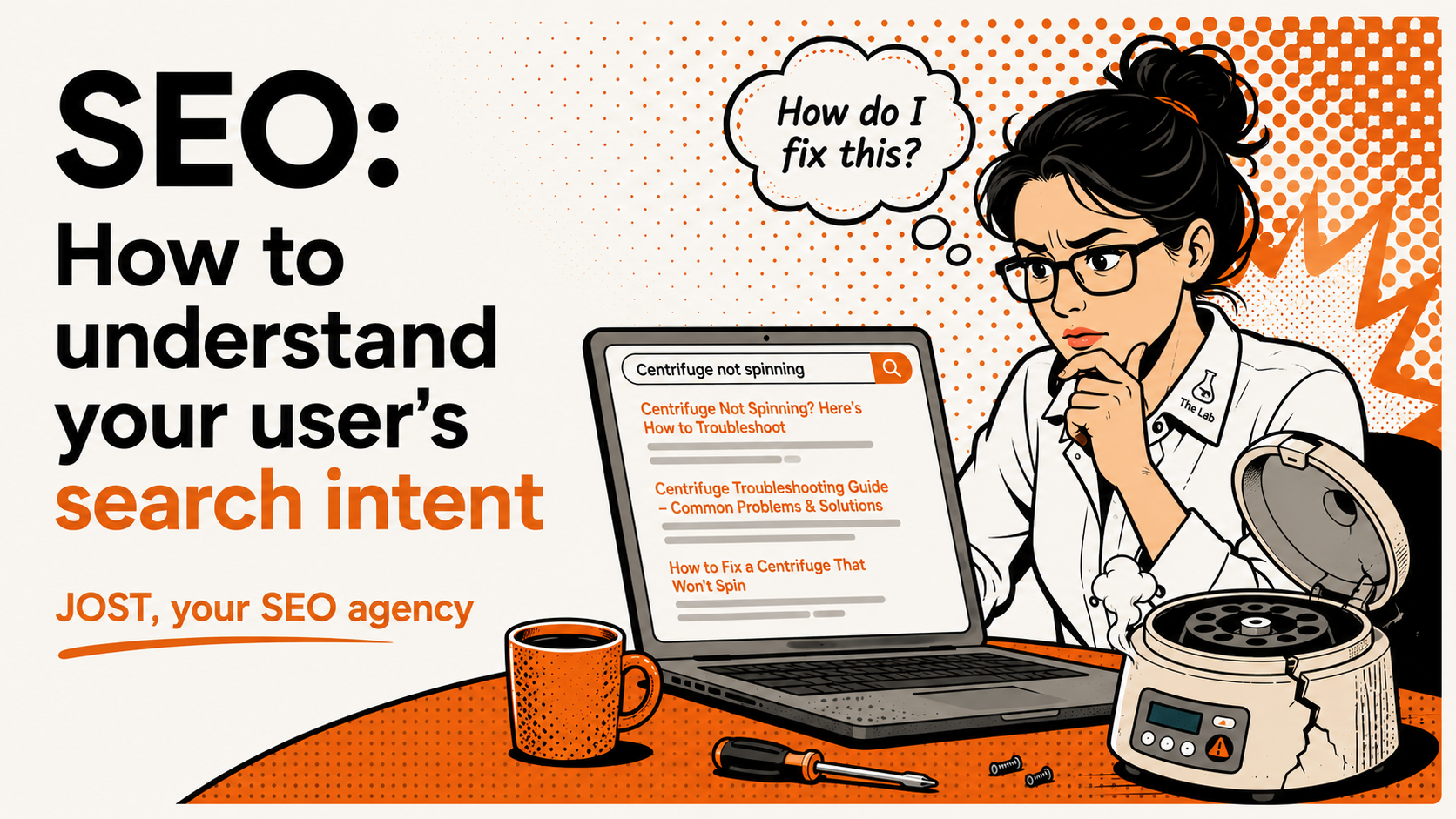
In this article, you will learn how the different types of search intent differ: from informational and navigational intent to commercial and transactional intent. And how to align your content in 2026 so that it performs well in both Google Search and AI-powered searches and AI overviews.
Contents
Why search intent has become more important than ever ⫸
The four types of search intent ⫸
How to determine the search intent of a keyword ⫸
How to optimize your content for search intent ⫸
Understanding Search Intent: Why the “Why” Behind a Search Query Determines Your SEO Success
Anyone who wants to be visible in search engines and AI-generated answers in 2026 must answer one question before writing a single line of content:
What is the person behind the search actually trying to accomplish?
That’s exactly what search intent (also known as user intent) describes: the goal and purpose behind a search query—the “what” and “why” behind every search entered into Google, ChatGPT, Perplexity, or any other search platform.
Think of search intent like walking into a store. Two customers may enter through the same door, but one is browsing, another is comparing products, and a third is ready to buy. Treating them all the same leads to missed opportunities. Search engines work the same way.
Why Search Intent Matters More Than Ever
Google Evaluates the Goal, Not the Keyword
Search intent has always been a core concept in SEO, but its importance has increased dramatically in recent years.
Google no longer primarily evaluates content based on keyword density. Instead, it measures how effectively a page satisfies the searcher’s underlying need. If your content misses the intent, it won’t rank—regardless of how technically optimized your website may be.
A useful analogy: Keywords are the address on an envelope. Search intent is the message inside. Google increasingly cares about the message.
AI Search Intensifies the Competition for Visibility
The rise of AI-powered search has raised the stakes even further.
Google’s AI Overviews, ChatGPT Search, and Perplexity can answer many questions directly without users ever visiting a website. Studies indicate that simple informational queries now frequently result in zero-click searches, where users get their answer immediately and never click through to a site.
At the same time, the click-through rate of the first organic search result has declined significantly since AI-generated summaries became more common.
The implication is clear:
Surface-level informational content that only addresses the most obvious intent generates less traffic than ever before.
The winners are organizations that go deeper than AI summaries by providing:
- Original data
- First-hand experience
- Expert insights
- Unique perspectives
Think of AI summaries as movie trailers. They give viewers the highlights, but people still seek out the full movie when they want depth, nuance, and expertise.
Brands that provide that depth are more likely to be cited by AI systems and earn valuable organic traffic.
Search Intent Beats Search Volume in Keyword Research
Search volume and keyword difficulty are important metrics, but they shouldn’t drive decisions on their own.
A keyword with lower search volume but strong commercial intent may be significantly more valuable than a high-volume informational keyword because the user is much closer to making a purchase.
Consider these two searches:
- What is CRM software? → Informational
- Best CRM software for manufacturing companies → Commercial
The second query may attract fewer searches, but the business value is often dramatically higher because the user is further along in the buying journey.
The Four Types of Search Intent
In SEO, four primary categories of search intent have emerged. While search intents often overlap, most queries have a clear primary intent and a secondary one.
1. Informational Intent
Informational searches are the original reason search engines exist: people want to learn or understand something.
Examples include:
- What is search intent?
- How does GA4 attribution work?
- How to set up event tracking in Google Analytics
Not every informational search is phrased as a question. A query like GA4 attribution setup still signals a clear desire to learn.
Google has become remarkably sophisticated at understanding context.
For example:
- Someone searching for “pancakes” is likely looking for recipes.
- Someone searching for “Earth” is likely seeking information about the planet.
Modern AI systems take this even further. They can understand conversational and spoken-language queries that resemble natural dialogue rather than traditional keywords.
2. Navigational Intent
With navigational intent, users already know where they want to go—they just use a search engine to get there.
Examples include:
- Chrome download
- LinkedIn login
- HubSpot pricing
A classic example occurs after a fresh Windows installation. Many users immediately search for “Chrome.” Google understands that they’re not looking for information about the browser—they want the download page.
For businesses, navigational keywords are largely about brand protection. If your company doesn’t rank first for its own name, competitors may capture traffic that was already looking specifically for you.
3. Commercial Intent
Commercial intent appears earlier in the buying process.
The user intends to purchase eventually but is still evaluating options.
Typical searches include:
- Best CRM for mid-sized businesses
- SEO agency comparison
- Salesforce vs. HubSpot
- Best project management software
These users are researching, comparing, and weighing alternatives.
Think of them as shoppers walking through a car dealership lot. They haven’t decided which vehicle to buy, but they’re clearly in the market.
Content that performs well at this stage includes:
- Comparison articles
- Product reviews
- Buyer guides
- Case studies
- Recommendation lists
This is also why many affiliate websites focus heavily on commercial-intent keywords.
4. Transactional Intent
Transactional intent is the clearest and most valuable form of intent.
The user is ready to take action.
Examples include:
- Buy iPhone 17
- Purchase software license
- Request a quote
- Book a demo
In these situations, the proverbial credit card is already sitting next to the keyboard.
For businesses, transactional keywords often represent the highest revenue potential—but they also tend to be the most competitive.
Whether targeting them is worthwhile depends on your website’s authority relative to the competition.
How to Determine the Search Intent Behind a Keyword
Understanding the theory is one thing. Applying it consistently is another.
Three methods work particularly well.
Use SEO Tools
Modern keyword research platforms such as SISTRIX, Seobility, and KWFinder often classify search intent directly within their reports.
This can save considerable time when evaluating large keyword sets.
Analyze the Search Results
Search Google for the keyword yourself and examine the top-ranking pages.
Ask:
- Are guides ranking?
- Product pages?
- Comparison articles?
- Videos?
- Category pages?
The search results page is Google’s most honest indication of how it interprets intent.
It’s essentially Google saying:
“This is the type of content users expect for this query.”
Pay attention not only to content format, but also to tone, perspective, and depth.
Ask AI Search Engines
A newer and increasingly valuable method is to analyze how AI-powered search systems respond.
Enter your keyword into:
- ChatGPT Search
- Perplexity
- Google Search with AI Overview
Observe:
- Which sources are cited?
- What follow-up questions are introduced?
- Which criteria are emphasized?
This reveals what AI systems consider intent-aligned content and often exposes gaps your own content can fill.
How to Optimize Content for Search Intent
Different intents require different strategies.
Two factors are especially important:
- How your content appears in search results
- How clearly users can take the next step once they arrive
Align Titles and Meta Descriptions with Intent
Your title tag and meta description should mirror the user’s intent precisely.
Someone seeking information wants a promise of a clear answer—not a marketing slogan.
Someone ready to buy wants reassurance around pricing, availability, trust, and credibility.
The closer your search snippet matches user expectations, the higher the likelihood of earning the click.
Create Clear Next Steps on the Page
Visitors should immediately recognize they’ve landed in the right place.
For informational content:
- Deliver the core answer early.
- Expand with supporting details afterward.
For commercial and transactional content:
- Make navigation intuitive.
- Present clear calls to action.
- Reduce friction in the conversion process.
In most cases, a dedicated landing page will outperform a generic educational article for transactional searches.
Search Intent in AI Search: What Changes in 2026?
Generative AI Prefers Verifiable Answers
The four traditional intent categories remain relevant.
However, AI systems increasingly favor content that provides:
- Clear answers
- Supporting evidence
- Specific metrics
- Transparent criteria
- Strong internal linking
- Structured data where appropriate
Content organized around a question-and-answer framework is more likely to be cited in AI-generated responses.
Think of AI systems as expert researchers working under extreme time pressure. They gravitate toward information that is clear, structured, and easy to verify.
GEO Is Not a Replacement for SEO
Generative Engine Optimization (GEO) and AI Optimization (GAIO) are becoming popular topics, but they do not replace traditional SEO.
In reality, most sources cited in AI-generated search experiences still come from pages that already rank highly in traditional organic search.
Classic SEO remains the foundation.
AI visibility is best understood as an extension of strong SEO—not an alternative to it.
Conclusion: Intent Before Volume
Search intent is not a secondary consideration in keyword research—it is the foundation of effective SEO.
Organizations that understand what users truly want—whether information, direction, comparison, or action—create content that succeeds in both traditional search results and AI-generated answers.
A practical framework looks like this:
- Identify the intent.
- Choose the right content format.
- Deliver clear, evidence-based answers.
- Create an obvious path to the next action.
- Measure the results.
At the end of the day, success isn’t determined by how many visitors arrive on your website.
It’s determined by whether the right visitors arrive.
Need Help with Your SEO and GEO Strategy?
Let’s analyze your target audience’s search intent together and develop a tailored SEO strategy.