
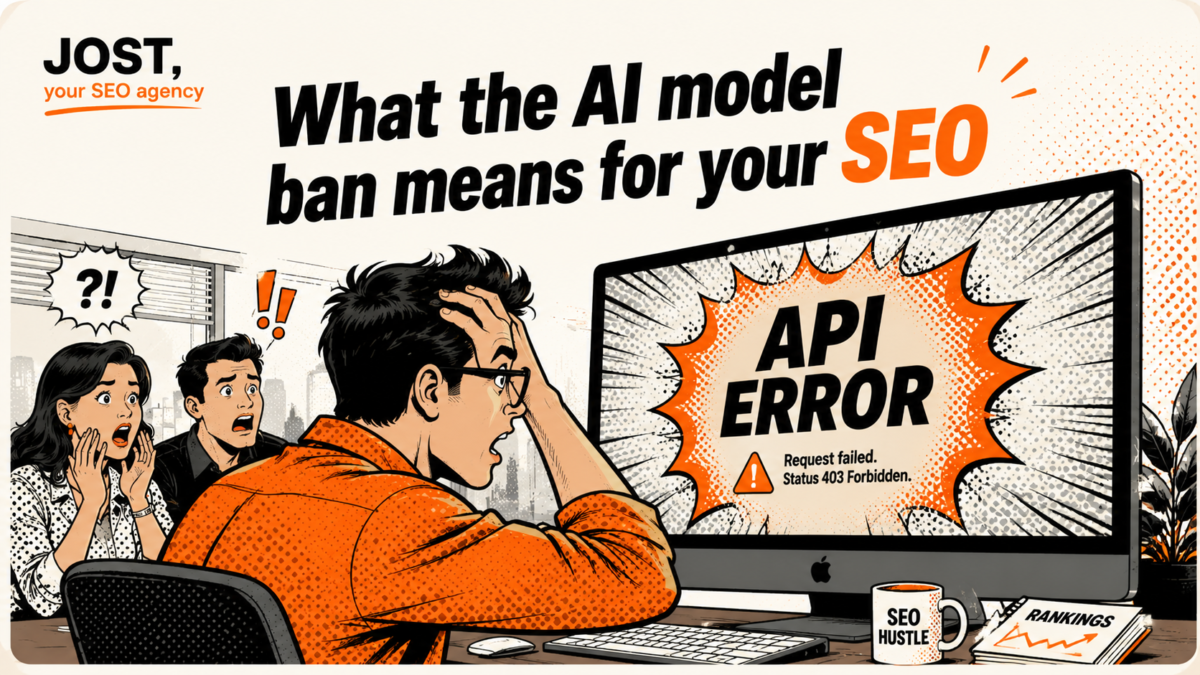
On June 12, 2026, the US government banned Claude Fable 5, the best AI for SEO, three days after launch. Learn what the shutdown reveals about relying on top tier AI models and discover how to build an SEO stack that survives the next blackout without unexpected cost or downtime.
Contents
What actually happened to Fable 5 ⫸
Finding 1: The Single-Switch Trap ⫸
Finding 2: The Weapons-Grade Data Risk ⫸
Finding 3: The Analysis Paralysis Trap ⫸
The US Government Just Killed the Best AI for SEO
Three days after Anthropic launched its most powerful AI model, the United States government had it completely switched off. Worldwide. Every customer, every country.
The immediate casualty? Modern SEO operations. Dozens of agencies and marketing teams had already migrated their entire SEO workflows onto this new tech, only to wake up to completely dead APIs and broken content pipelines.
By the end of this article, you will know:
- Why an AI setup that looks like the absolute latest and best is actually a ticking time bomb for your business operations.
- What a classified dispute between Anthropic and the U.S. government reveals about the safety of your private data.
- The three structural shifts you need to make to your SEO stack today before something like this happens to you.
Here is what happened
On June 9, 2026, Anthropic released two groundbreaking artificial intelligence models: Fable 5 and a highly exclusive, partner-only model called Mythos 5. These weren’t routine, minor upgrades. Early testers at respectable tech companies reported how Fable 5 compressed months of complex engineering into a single day. For some SEO practitioners, it was a total game-changer.
The model possessed massive, long-running execution capabilities, handled advanced intent analysis, and helped to audit thousands of landing pages in a single run without timing out.
And of course, a few aggressive SEO agencies started to deploy Fable 5. In those first 72 hours, some practitioners moved almost 100% of their operations onto Fable 5: running full technical site audits, restructuring broken heading hierarchies or automatically writing highly optimized content briefs. One agency founder told me how Fable 5 was already handling his complete content production pipeline. He shifted his entire livelihood onto a model he had known for three days.
And three days later, it was confiscated.
On Friday, June 12, 2026, the federal government issued an emergency export-control directive. The administration claimed they detected a security flaw that let malicious hackers leverage the model. To block it, they banned any foreign national from touching the tech.
This is where it gets interesting: That ban applied to anyone inside the United States who wasn’t a U.S. citizen—including Anthropic’s own software engineers in San Francisco. With no way to cleanly separate users on a Friday night, Anthropic chose the nuclear option. They killed both models for every single user on Earth to stay legal. Here is Anthropic’s press release about the ban.
Here is my take: Up until recently, we took access to top-tier models for granted. But, it turns out that this belief is based on an illusion. A tool you depended on to drive your rankings on Monday was wiped out by Thursday. Not because your strategy was wrong, but because someone with more leverage than you decided it was over.
This disruption boils down to three major findings, and each one really changes how you should build your SEO operations.
Finding 1: The Single-Switch Trap
Too many marketing departments are running on a highly fragile infrastructure: one provider, one API endpoint, and one single point of failure standing between them and a total business blackout.
Relying entirely on a single AI model is like renting your digital storefront from a landlord who can change the locks out of nowhere and without notice. And that landlord doesn’t have to be a government agency. It can be:
- An unannounced price hike.
- A sudden policy change regarding scraped data.
- An unexpected server outage.
- A quiet quality downgrade that tanks your content quality without you realizing it.
What this costs you depends entirely on how you insulate your workflow. If you pointed your live content pipeline straight into a single model, this shutdown was a business-threatening emergency. If you built your system with redundancy, it was a five-minute fix.
Your Move
Don’t rely on your favourite AI model, don’t see it as the engine for your company. The language model is just like electricity, a commodity, a utility. However, your business is your proprietary electrical grid, filled with your own intellectual property. If one power plant goes down, your grid should automatically pull power from another source.
Build your workflow so you can switch power lines instantly. If Fable goes dark, slide Opus in. If Opus fails, swap to GPT. When you decouple your architecture, a sudden government intervention becomes a minor settings adjustment rather than a corporate crisis.
Finding 2: The Weapons-Grade Data Risk
Every day, too many SEO teams pour parts of their proprietary keyword data, competitive positioning, top-converting copy, and exact customer search insights straight into commercial AI models. Business owners treat this like a standard software subscription, no different than paying for some email hosting or a basic CRM.
But these AI providers are no longer normal software vendors.
To understand why, we have to look at the timeline behind the shutdown. Back in July 2025, the Department of Defense awarded massive technology contracts worth up to two hundred million dollars each to Anthropic, OpenAI, Google, and xAI. Claude quickly became the military’s most widely deployed elite model, used for intelligence analysis on classified government networks.
The friction escalated rapidly in early 2026 when the Pentagon demanded Anthropic permit its models to be used for “all lawful purposes.” Anthropic drew a firm line at two uncompromisable red lines: mass domestic surveillance of U.S. citizens and fully autonomous weapons. The Pentagon wanted those doors open; Anthropic kept them locked.
The retaliation was swift. On February 27, 2026, the administration directed all federal agencies to immediately stop using Anthropic, blacklisting the company as a national security risk. While a federal judge granted an initial block against this ban in March 2026, the damage was done. By June 2026, the Pentagon shifted two-thirds of its AI workload away from Anthropic, and OpenAI stepped right in to take over those defense contracts.
That’s how fast the world changed: The exact same model you use to write meta descriptions is now being fought over as a dual-use military asset.
AI is no longer commercial software; it is a highly regulated weapon of state power. When you feed your entire organic strategy into these endpoints, you are shipping your intellectual property into a corporate black box that you cannot open, cannot audit, and cannot protect.
That’s why your data and your context information should live completely outside the model. Your prompts, brand guidelines, content briefs, and semantic structures must be versioned, governed, and safely stored on your side of the wall. Treat the model as a utility you rent for a single task, while keeping the actual data assets under your strict ownership.
Finding 3: The Analysis Paralysis Trap
Too many operators paralyze their businesses by constantly chasing the newest, most expensive mega model. They waste weeks running benchmarks, obsessing over prompt engineering, and waiting for the next massive model drop—all while publishing absolutely nothing.
Meanwhile, the competitor down the street builds a simple, repeatable system using mid-tier models, ships 20 optimized pages, and captures the search traffic while everyone else is still reading software reviews.
The hard data shows that you do not need the most expensive model to win the Google rankings. OpenRouter recently conducted a benchmark test (DRACO) across 100 deep-research tasks—the closest public equivalent we have to high-level SEO research, entity mapping, and intent analysis. (“Surpassing Frontier Performance with Fusion“)
They utilized an approach called Fusion: instead of using one giant model, they distributed the task across a panel of smaller models and used a separate judge-model to combine the findings into a single, cohesive output.
The results were stunning:
- A panel combining three budget-friendly models, Gemini Flash, Kimi, and DeepSeek, outperformed GPT-5.5.
- It also beat Claude Opus.
- It matched Fable 5 within a single percentage point, at a mere fraction of the operational cost.
- Even Fable itself scored significantly higher when fused with GPT than it did running completely solo.
OpenRouter Fusion surpasses
the frontier
Mean normalized score across 100 deep‑research tasks, Data Source: Brian Thomas · 6/12/2026 · OpenRouter >
Your Move should be to stop overpaying for a single “genius” model. Model diversity functions exactly like a specialized human team. Combining three distinct, affordable perspectives consistently outperforms a single isolated model, slashes your API bills, and protects your production output from being vulnerable to any single company’s availability.
Your Defense Blueprint
The global shutdown of Fable 5 didn’t ruin SEO; it simply exposed the structural flaws of building on quicksand. To insulate your search traffic from future blackouts, remember these three rules:
- Treat models like swappable utilities, so a sudden outage costs you zero downtime.
- Keep your data context on your own servers, so your intellectual property is never trapped inside a regulated black box.
- Combine cheap model panels, to get elite-level research output at a fraction of the price.
At the end of the day, a commercial language model was never your long-term competitive advantage. You already know that entity clarity, good content architecture, sufficient internal linking and your focus on user intent are among the assets that truly defend your business. And none of those are hidden inside someone else’s model.
Need Help with Your SEO and GEO Strategy?
Let’s analyze your target audience’s search intent together and develop a tailored SEO strategy.